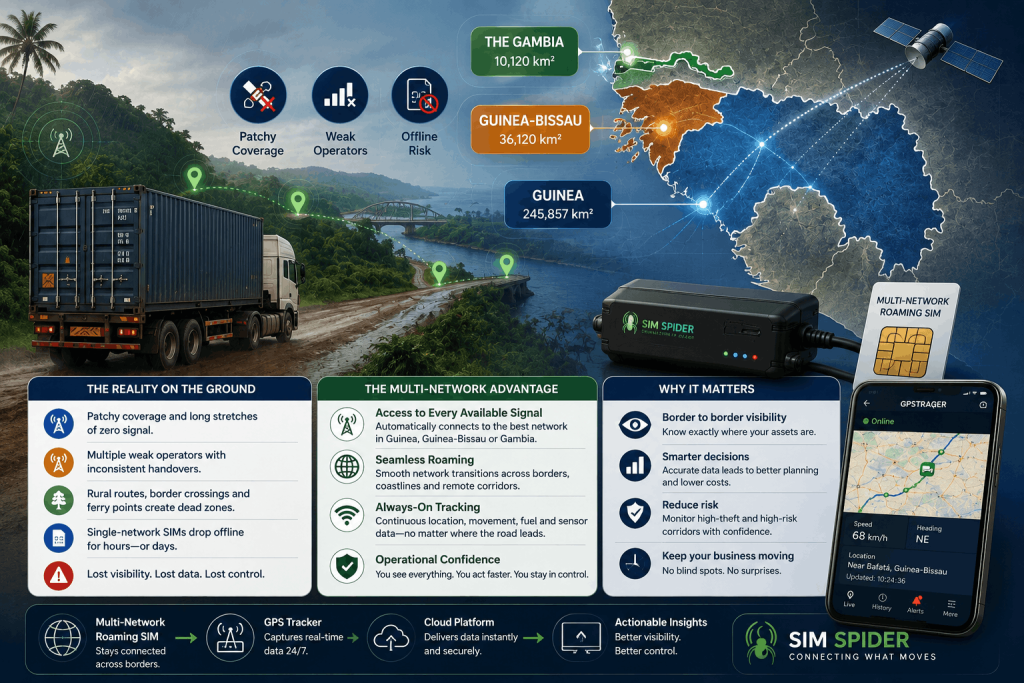
Some of the hardest places to keep a GPS tracker online are not the largest countries. They are the smallest, the most rural, and the most overlooked by global network planners. Guinea, Guinea-Bissau, and Gambia fall squarely into that category. Between them, they cover barely 400,000 square kilometers, yet the logistics of tracking assets across their territories can frustrate fleet managers more than running trucks across the entire Sahel.
We regularly hear from operators in these markets who assumed a standard SIM would suffice, only to discover that “coverage” on a coverage map means something very different on the ground. A single carrier might hold a license for the whole country, yet only operate towers along the main highways. Step fifty Kilometres off the tarmac and the signal vanishes. Cross a border into a neighboring state to avoid a flooded road and the tracker dies completely because the SIM has no roaming agreement there.
The reality on the ground: In Guinea-Bissau, and Gambia, network coverage is not a given. It is a patchwork. And if your SIM cannot hop between whatever towers are available, Your tracker becomes a silent black box precisely where you need visibility most.
Why These Three Markets Are Especially Difficult
West Africa is often discussed as a single region, but the challenges vary dramatically between Nigeria’s congested LTE corridors and the sparse, legacy-GSM networks of the smaller coastal and riverine states. Guinea, Guinea-Bissau, and Gambia share a set of specific connectivity handicaps:
Limited tower density
Outside Conakry, Bissau, and Banjul, cellular infrastructure is thin. Rural mining sites in Guinea’s interior, cashew collection points in Guinea-Bissau’s forests, and fishing landing sites along Gambia’s riverbanks often sit beyond the range of any single carrier’s footprint.
2G dependency
Many areas in all three countries are still served by GPRS or EDGE infrastructure. Modern LTE-only SIMs or trackers without 2G fallback simply cannot attach. A device that works perfectly in Dakar may be completely useless in Koundara.
Border strangulation
Gambia is a narrow enclave surrounded by Senegal on three sides. Trucks moving from Banjul to the Casamance region must transit Senegalese territory. A Guinea-Bissau cashew export route to the port of Dakar crosses both Guinea and Senegal. If the SIM is locked to one national network, these unavoidable cross-border segments become tracking blind spots.
Power instability
Rural towers often rely on diesel generators with intermittent refuelling. A tower that is “live” on paper may be offline for days during fuel shortages. Multi-network roaming provides the only practical resilience: if Orange’s tower is down, perhaps MTN’s generator is still running.
For operators moving high-value exports — bauxite from Guinea’s mines, cashew nuts from Guinea-Bissau’s cooperatives, or refrigerated fish from Gambia’s Atlantic fleet — these gaps translate directly into theft risk, insurance disputes, and contract penalties.
What Multi-Network Roaming Actually Means
In mature European or North American markets, a multi-network SIM is a nice-to-have redundancy feature. In Guinea, Guinea-Bissau, and Gambia, it is survival equipment. The reason is simple arithmetic: there are fewer towers per square kilometre here than almost anywhere else on the continent, and those towers belong to different carriers with wildly uneven footprints.
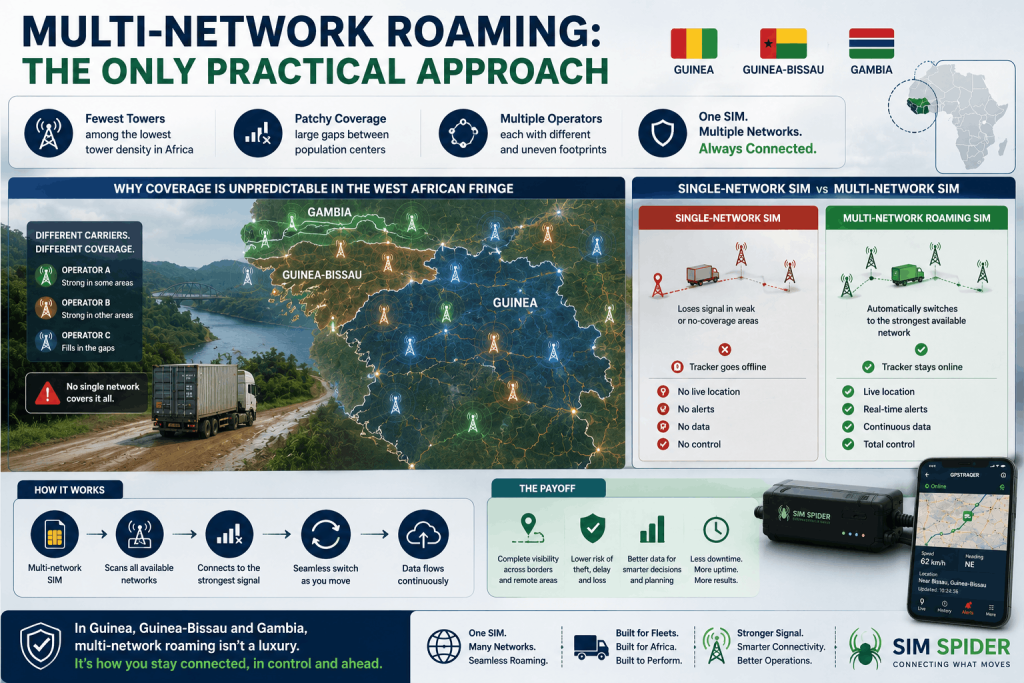
Our multi-network SIMs are provisioned to attach to any available GSM or LTE carrier in the country — Orange, MTN, Airtel, or whichever local operator happens to hold the licence for that specific region. There is no home-network preference forcing the device to cling to a weak signal. If the strongest available tower belongs to a different brand, the SIM registers there automatically.
In practical terms for a logistics manager:
- A mining convoy leaving Conakry for the Boké bauxite belt may start on Orange, switch to an MTN tower in the Fouta Djallon highlands, and fall back to 2G on Airtel in the remotest stretches — all without the driver touching the device or the dispatcher reconfiguring anything.
- A refrigerated truck hauling fresh fish from Banjul to Dakar maintains data connectivity across the entire Senegalese transit corridor because the SIM is not nation-locked. The APN never changes. The data allowance never incurs a roaming surcharge.
- An asset tracker on a cashew shipment from Gabú, Guinea-Bissau, heading to the port of Bissau finds the one available tower in a hundred-kilometre radius, regardless of which operator owns it.
One flat monthly rate. One APN. Automatic fallback across every carrier in the country— and across borders without penalty.
Hardware That Survives the Environment
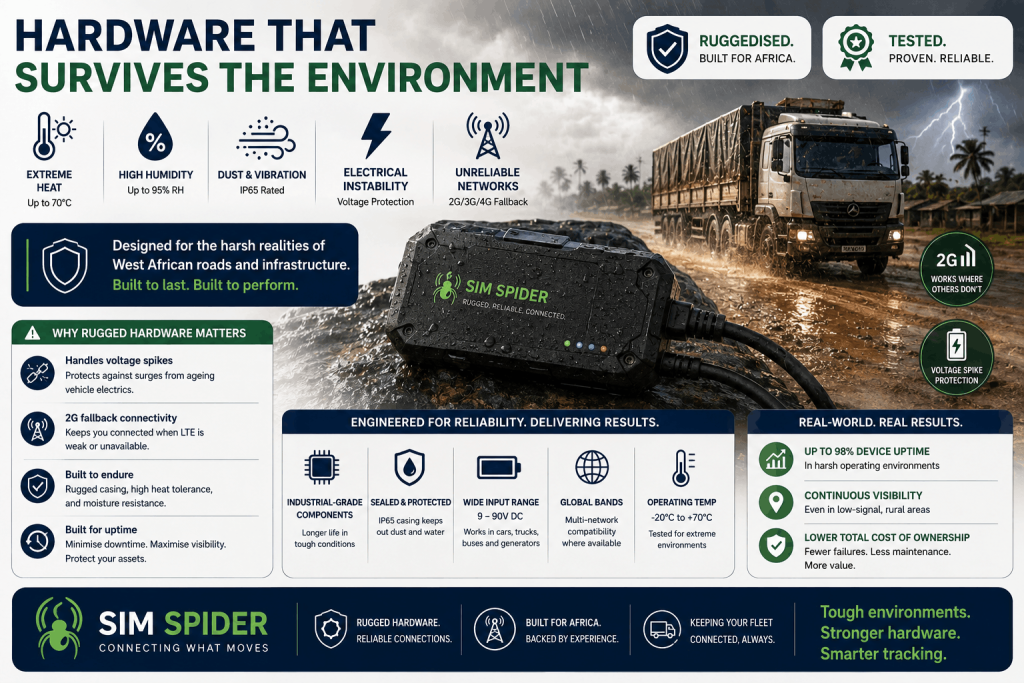
The West African coast is hot, humid, dusty, and electrically unstable. Consumer-grade tracking hardware fails quickly here. We see the most reliable results from ruggedised devices that can handle voltage spikes from ageing vehicle electrics and still transmit on 2G when LTE is absent.
The Teltonika FMC125 and FMB120 are the workhorses in this region for good reason. Both support 4G LTE with automatic 2G fallback, CAN-bus integration for engine diagnostics, and ignition-based reporting that suppresses false alerts when a vehicle is parked. Their IP-rated enclosures handle the dust and moisture that destroy lesser units within months.
We ship these devices pre-configured with our multi-network SIM and the correct APN already programmed. The mechanic clips red to battery positive, black to negative, and the unit is live. There is no SMS configuration dance, no APN memorisation, no risk of a mistyped setting leaving the tracker mute for weeks until a technician can reach it.
Data Usage in Low-Bandwidth Environments
Ironically, the very scarcity of network infrastructure in these countries keeps data consumption low. When a tracker can only find a 2G tower and reports every ten minutes rather than every thirty seconds, it uses far less data than the same device in a 4G-dense city. A typical asset tracker in Guinea-Bissau or rural Gambia consumes well under 5 MB per month.
For a mining contractor in Guinea running ten vehicles with more aggressive reporting — location every two minutes plus ignition and speed data — the monthly usage per SIM is still only in the 5–15 MB range. At USD 2.00 for 5 MB or USD 3.50 for 15 MB, the monthly connectivity cost for the entire fleet is negligible compared to fuel, security escorts, or vehicle depreciation.
Where operators occasionally run into trouble is assuming that “unlimited” or high-capacity plans are necessary. They are not. The bottleneck is not data volume; it is network availability. A 50 MB plan on a single-network SIM that cannot find a tower is worthless. A 5 MB plan on a multi-network SIM that hops between whatever towers exist delivers real value.
From the Field: Typical Deployment Scenarios
A mining support contractor moves equipment and personnel between Conakry and interior sites near Kankan and Siguiri. The route passes through areas where only one carrier has a tower — and that tower may be offline for maintenance. With a multi-network SIM, the tracker simply attaches to whichever network is alive. The dispatcher sees the convoy’s progress in real time, can anticipate delays, and knows immediately if a vehicle deviates from the approved route.
Guinea-Bissau is one of the world’s largest cashew exporters, yet its road network remains largely unpaved. Collectors drive deep into the forest to buy nuts from village cooperatives. A tracker on these collection vehicles provides the export house with visibility into whether the supply chain is moving or stalled. Without multi-network roaming, a collector who drives two hours off the main road simply disappears from the system until he returns to Bissau or Gabú.
Gambia’s fishing fleet lands catch at multiple sites along the River Gambia and the Atlantic coast. Refrigerated trucks collect the fish and run either to Banjul for local processing or across the Senegalese border for Dakar export. Single-network SIMs fail at the border crossing and in the rural landing sites where only one carrier bothers to maintain a tower. Multi-network roaming keeps the cold-chain visible from boat to processing plant.
Platform Control: GPSTRAQER and Sim Spider
Connectivity and hardware solve the physical problem. The platform layer solves the operational one. Our ecosystem is designed for fleet managers who cannot afford to babysit individual SIMs or manually reconcile tracking data from multiple countries.
- GPSTRAQER.com aggregates live position data, route histories, geofence breaches, and driver behaviour events across the entire fleet — regardless of which country or network each vehicle is currently attached to. A manager in Conakry sees the same dashboard clarity as a manager in London
- Sim Spider provides the SIM control plane: activate or deactivate individual SIMs remotely, monitor real-time data consumption against the monthly plan, set usage alerts, and top up via credit card or PayPal. If a vehicle is stolen in rural Guinea, the SIM can be disabled from the portal within seconds, rendering the tracker useless to thieves who might try to redeploy it.
Together, they turn sporadic network availability into continuous operational intelligence.
The Bottom Line
Guinea, Guinea-Bissau, and Gambia are not afterthought markets. They are high-growth, resource-rich economies where the lack of infrastructure creates exactly the kind of visibility gaps that GPS tracking was invented to solve. But standard consumer SIMs — single-network, nation-locked, APN-specific — are not fit for this environment. They were designed for city dwellers with a choice of coffee shops, not for mining convoys in the Fouta Djallon or fishing boats on the River Gambia.
Multi-network roaming is not a premium add-on in these countries. It is the baseline requirement for any tracking deployment that expects to work outside the capital city. The cost of a dead tracker — a stolen load, a missing vehicle, a spoiled pharmaceutical shipment, an insurance claim disputed for lack of evidence — far exceeds the cost of a SIM that simply finds whatever network is available and gets on with the job.
If your fleet, assets, or supply chain operate in Guinea, Guinea-Bissau, or Gambia, the only question that matters is whether your SIM can survive the reality of West African infrastructure. Ours can.