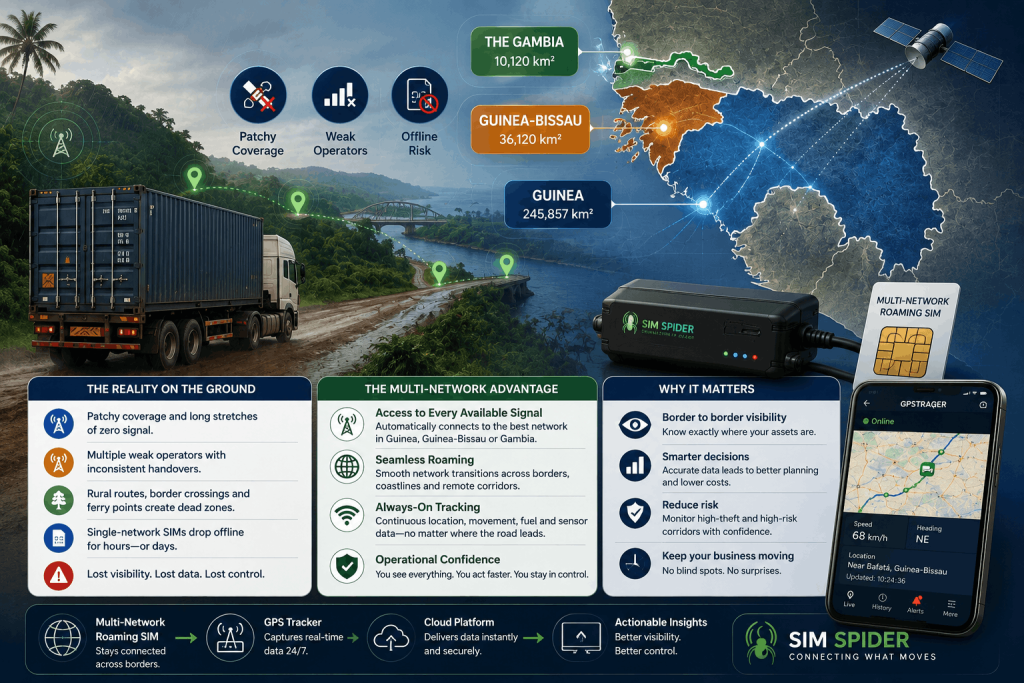
Running a fleet across Southern Africa is not like running a fleet in Western Europe. A truck leaving Lusaka bound for Durban may pass through five distinct mobile network footprints in a single day. The SIM card inside your GPS tracker decides whether your dispatch office sees that vehicle in real time — or sees a blank screen for six hours.
We speak to fleet operators every week who have learned this the hard way. A single-network SIM that works perfectly in Zambia dies the moment the truck crosses into Zimbabwe. A local SIM from South Africa roams at punitive rates in Botswana and offers no signal at all in rural DRC. The result is predictable: lost visibility, delayed deliveries, fuel theft going undetected, and dispatchers working blind.
The Core problem: GPS trackers are only as good as the network they network they connect to. If the SIM cannot find a tower, the most expensive tracker on the market becomes a dashboard ornament.
THE SADC Corridor Challenge
The Southern African Development Community (SADC) Region fifteen countries with overlapping but incompatible network infrastructures. A fleet operator running cross-border routes faces three consistent connectivity problems
Network Fragmentation
Vodacom dominates in South Africa and parts of DRC. MTN holds strong in Zambia and Uganda. Airtel is critical in Malawi and Tanzania. No single carrier covers every route.
2G sunset gaps
Many older trackers still rely on GPRS. As carriers retires 2G in favour of LTE, devices on single-network legacy plans lose data connectivity entirely — even where voice signal appears strong.
APN chaos
Each local SIM requires a different APN. Managing ten APN profiles across a fifty-truck fleet is an administrative nightmare, and one misconfiguration silences the tracker until a technician can physically reach it.
For a logistics company managing high-value cargo — fuel, mining equipment, refrigerated pharmaceuticals — these gaps are not minor inconveniences. They are operational risks with direct financial consequences.
What Multi-Network Roaming Actually Means

Most People hear “roaming” and think of their mobile phone bill after a holiday. M2M roaming is different. Our SIMs do not attach to one home network and pay surcharges abroad. They are provisioned as true multi-network subscribers, authorized to register on any available GSM or LTE carrier in the country — automatically, In real time, with no manual intervention
in Practical terms:
- A truck leaving Johannesburg on MTN switches seamlessly to Vodacome when MTN drops, then to Orange in the DRC, then to Airtel in Malawi — all on the same SIM, same APN, same data allowance.
- There is no "home network" bias. The SIM evaluates signal strength and registration success and attaches to the strongest available tower, regardless of brand.
- The fleet manager sees one flat monthly rate per SIM. There are no roaming surcharges, no top-up surprises, no cross-border billing complexity.
One SIM. One APN. One invoice. Fifteen countries
Hardware That Matches the Network
Connectivity is only half the equation. The tracker itself must be capable of exploiting the networks available. We see many operators in Southern Africa deploying Teltonika FMC125 and FMB 120 devices and for good reason. These units support 4G LTE with 2G fallback, which is essential in detection, and remote immobilization features that matter when you are managing driver behavior and cargo security across multiple jurisdictions.

We ship these devices pre-configured with our multi-network SIM already installed. The customer connects red to positive, black to negative, and vehicle is live on the map. No APN configuration, no SMS setup scripts, no technician visits.
We speak to fleet operators every week who have learned this the hard way. A single-network SIM that works perfectly in Zambia dies the moment the truck crosses into Zimbabwe. A local SIM from South Africa roams at punitive rates in Botswana and offers no signal at all in rural DRC. The result is predictable: lost visibility, delayed deliveries, fuel theft going undetected, and dispatchers working blind.
Data Plans Built for Real-World Usage
A common misconception is that cross-border tracking consumes enormous data. It does not. A Teltonika FMC125 sending location, speed, and ignition status every thirty seconds uses roughly 5–15 MB per month. The bulk of data consumption comes from protocol overhead and TCP keepalives, not from the position reports themselves.
For lighter asset trackers reporting every few hours, the 5 MB plan at USD 2.00 is sufficient. For heavy CAN-bus telemetry or dual-protocol redundancy, the 30 MB plan at USD 5.00 provides a comfortable buffer. We size the plan to the use case — and if the data requirement exceeds our standard tiers, we say so honestly rather than pushing an unsuitable product.
For a typical SADC fleet operator running twenty trucks:
- 15 MB per SIM per month covers real-time tracking with headroom for remote commands and geofence alerts.
- At USD 3.50 per SIM, the monthly connectivity bill for the entire fleet is USD 70 — predictable, flat, and unaffected by which countries the trucks pass through.

From Theory to Practice
Consider a typical scenario: a freight operator running a daily from Zambia through Zimbabwe to South Africa. With a single-network local SIM, the tracker drops offline at the chirundu border crossing of two to three hours while the driver negotiates customs. The dispatch office has no visibility into whether the truck is stationary in a queue, rerouted, or delayed by a breakdown. Fuel monitoring stops. Temperature alerts for refrigerated cargo cannot reach the platform.
With a multi-network roaming SIM, the tracker re-registers on the available Zimbabwean network within minutes of crossing. The APN never changes. The data session resumes automatically. The dispatch office sees continuous location history, receives the geofence entry alert at the border, and knows exactly when the truck clears customs and re-enters transit.
This is not a hypothetical benefit. It is the difference between a fleet management system that works most of the time and one that works every time.
Platform Visibility: SIM Spider and GPSTRAQER
Connectivity and tracking hardware are only valuable if the fleet manager can act on the data. Our ecosystem includes two platforms designed for exactly this operational reality:
- GPSTRAQER.com provides live mapping, route history, geofencing, and driver behaviour analytics across the entire fleet — regardless of which country each vehicle is in.
- Sim Spider handles the SIM layer: remote activation and deactivation, real-time data consumption monitoring, usage alerts, and credit-card top-ups. If a vehicle is stolen or a route is suspended, the SIM can be disabled instantly from the web portal.

The Bottom Line
Cross-border fleet tracking in Southern Africa is not a connectivity luxury. It is an infrastructure requirement. Single-network SIMs were designed for domestic consumer phones, not for trucks that earn their revenue by moving between countries. The cost of a dead tracker — missed theft, delayed recovery, uninsured cargo loss, customer penalties — far exceeds the cost of a properly provisioned multi-network SIM.
If your fleet operates across Zambia, Zimbabwe, South Africa, Botswana, Malawi, Tanzania, or the DRC, the question is not whether you can afford multi-network roaming. It is whether you can afford the alternative.
Laura Hermes
Sales Assistance - MENA
Office: +44-2033188 201-7
Web: https://ext.m2mgs.com
M2M Global Solutions Ltd
20-22 WENLOCK ROAD, ISLINGTON- LONDON, N1 7GU, United Kingdom