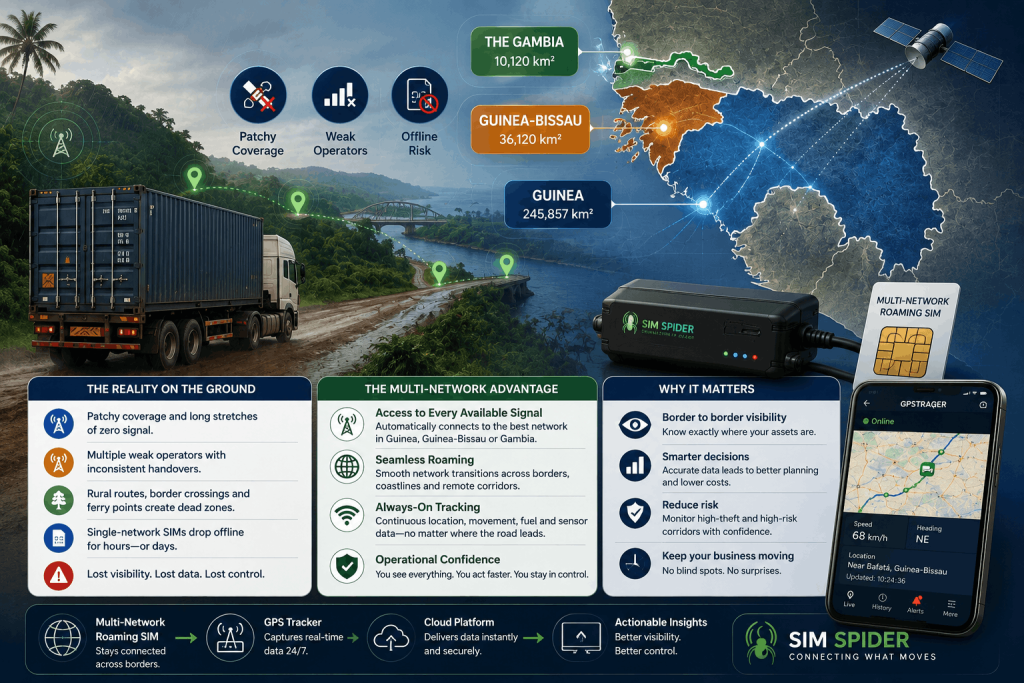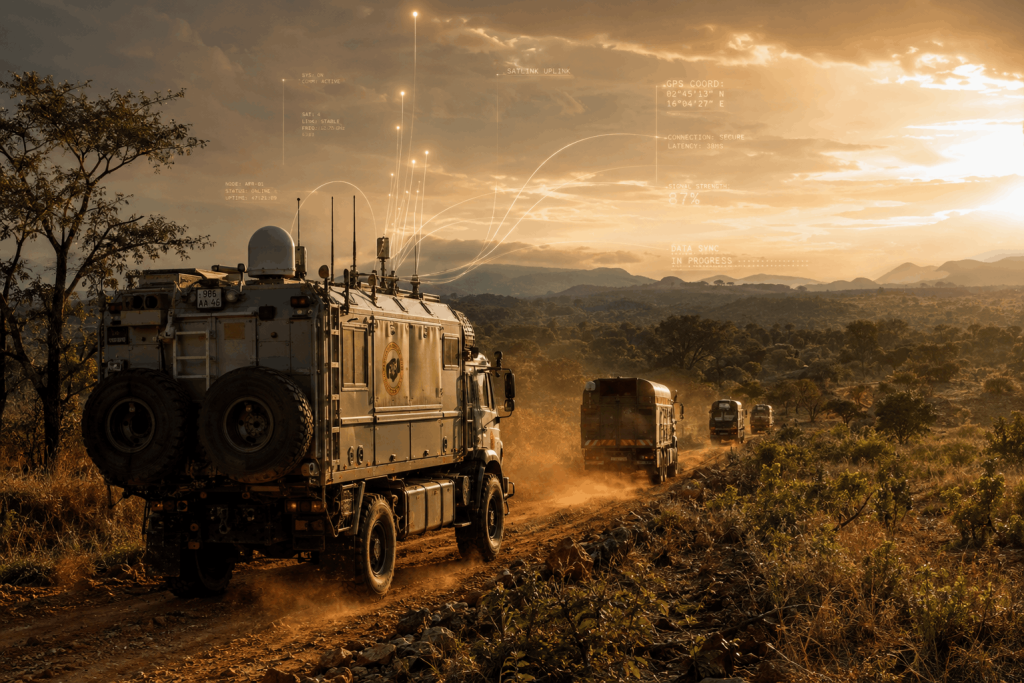
There is a vast belt of Central Africa where mobile coverage exists in theory disappears in practice the moment you leave the main road. Cameroon, Chad and the Central African Republic sit at the heart of this belt. For fleet operators, aid organizations, mining contractors, and security firms working across these territories, the challenge is not merely finding a signal – it is keeping a signal as vehicles and assets move through some of the most logistically demanding environments on the continent.
We speak to operators in these markets who have tried local SIMs, regional roaming agreements, and event satellite backup systems, yet still face the same problem: their GPS trackers go dark exactly where they need visibility most. A uranium convoy in northern Chad. A timber hauler crossing into the Central African Republic from eastern Cameroon. A medical supply truck running the N’Djamena-Bangui corridor. These are not edge cases. They are the daily reality of working in Central Africa
The Central African reality: In Cameroon, Chad, and CAR, mobile infrastructure is concentrated in the capital cities and along major transport corridors. Step off those corridors and you enter a connectivity wilderness. Single-network SIMs simply cannot survive here.
Why These Three Markets Defy Standard Connectivity
Each of these countries presents a distinct connectivity profile, but they share one common trait: the gap between official coverage maps and actual usable signal is wider here than almost anywhere else in Africa.
Cameroon — the bifurcated Network
Douala and Yaoundé enjoy relatively dense LTE infrastructure, but the northern regions bordering Chad and the eastern regions approaching CAR are served by sparse 2G networks with long dead zones. A truck moving from Douala to Garoua or from Yaoundé to Bertoua and on toward Bangui crosses from 4G into GPRS into nothing, then back into a weak 2G signal from a single distant tower. The network landscape changes every hundred kilometres.
Chad — the landlocked desret
This is one of the most challenging connectivity environments on Earth. Outside N’Djaména, Abéché, and a handful of oil-field installations, cellular coverage is thin, patchy, and overwhelmingly 2G. Airtel and Tigo hold the market, but their rural footprints are dictated by commercial viability, not by the needs of mining or logistics operators who must move across the Sahel and into the Sahara. Dust, heat, and extreme temperature swings destroy consumer-grade hardware within months.
Central African Republic — the near-wilderness
Bangui has workable 3G and 4G in places, but the moment a vehicle leaves the capital, the digital world ends. The road network itself is largely unpaved. National routes to the borders with Cameroon, Chad, and the DRC pass through hundreds of kilometres of forest and savannah with no permanent cellular infrastructure. Aid convoys, mining exploration teams, and timber operators all face the same problem: they are effectively off-grid, yet they still need asset visibility for security, insurance, and operational control.
For any operator moving assets across the borders between these three states — Cameroon into Chad at Kousséri, Chad into CAR at Sido, or Cameroon into CAR at Gamboula — the connectivity challenge compounds. A SIM that works in N’Djaména may die at the border. A tracker live in Douala may fall silent in eastern Cameroon and never reappear until Bangui, if at all.
Multi-Network Roaming in the Central African Context

In these conditions, a multi-network roaming SIM is not a convenience. It is the difference between operational control and operational blindness. The reason is not merely the ability to switch carriers. It is the ability to switch carriers in real time as the vehicle moves through territories where no single operator has bothered to build a complete network.
Our SIMs are provisioned to register on any available GSM or LTE carrier in the country without home-network bias. In practical terms for Central Africa:
- A mining convoy leaving Douala for the Far North region of Cameroon starts on MTN or Orange in the city, automatically switches to whichever carrier holds the sparse licence in the Adamawa highlands, and maintains GPRS contact long after a single-network SIM would have lost the tower entirely.
- An aid logistics truck running from N'Djaména to Abéché and onward toward the CAR border finds the one available Airtel or Tigo tower in a two-hundred-kilometre radius. If that tower is down for maintenance or fuel shortage, the SIM attempts the alternative carrier automatically. There is no driver intervention, no SMS reconfiguration, no dispatcher panic.
- A timber or mining operation in western CAR, with vehicles moving between Bangui and the Cameroon border, attaches to Orange or MTN when within range, falls back to 2G when necessary, and resumes data sessions the moment any viable signal returns. The APN never changes. The data plan never incurs a border surcharge.
The SIM does not care which brand owns the tower. It cares whether the tower is alive. In Central Africa, that distinction is everything.
Hardware That Survives the Environment
Central Africa is not kind to electronics. The heat in northern Chad exceeds fifty degrees Celsius in the shade. The humidity in southern Cameroon and CAR roasts circuit boards. The dust across the Sahel infiltrates every connector. Voltage spikes from ageing vehicle electrics fry consumer-grade trackers within weeks
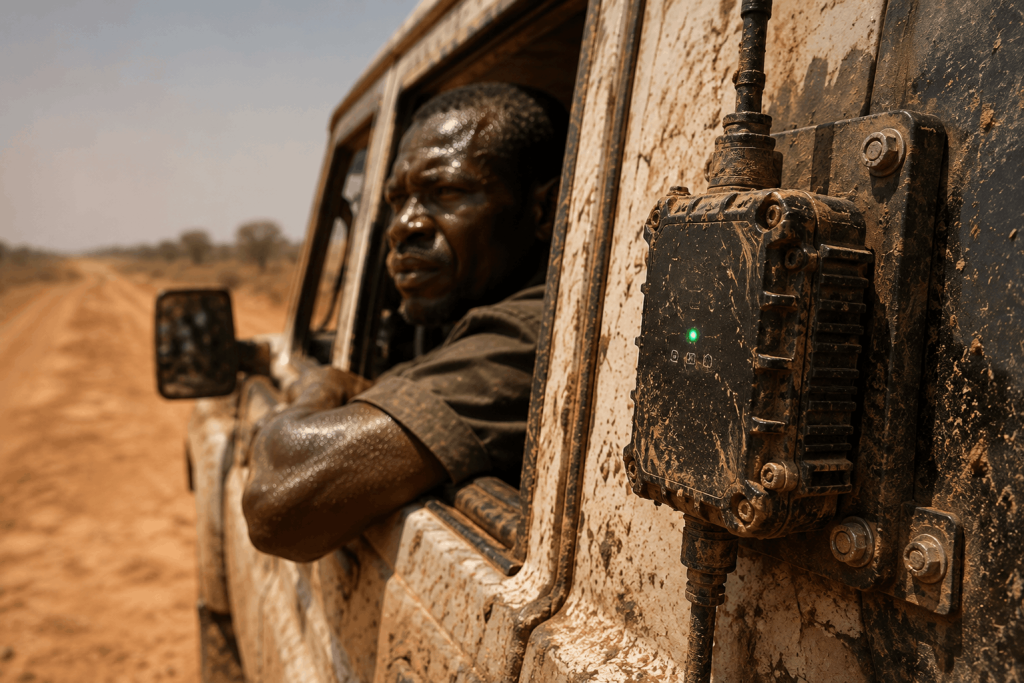
We deploy Teltonika FMC 125 and FMB 120 units in this region because they are built for exactly these conditions. Both support 4G LTE with automatic 2G fallback — essential in chad and rural CAR where LTE is still a rarity. Their CAN-bus integration allows engine diagnostics and fuel monitoring, which matters enormously when fuel theft is a persistent operational risk. The ignition-detection logic suppresses false alerts when vehicles are stationary, and the IP-rated enclosures handle dust ingress and moisture that destroy lesser devices.
We ship every device pre-configured with our multi-network SIM and correct APN already loaded. The installer connects two wires. The tracker is live. There is no configuration script to memories, no risk of a mistyped APN leaving the unit silent for weeks in a region where technician callouts cost more than the hardware itself
Data Reality in Low-Infrastructure Markets
The critical insight is that data volume is rarely the problem in Central Africa. Network existence is the problem. A multi-network SIM that can find some signal with a 5 MB plan is infinitely more valuable than a 50 MB plan on a SIM locked to a dead network.
One of the counterintuitive truth about tracking in Cameroon, Chad, and CAR is that data consumption is often lower than in better-connected countries. The reason is simple: when a tracker spends hours between towers, it simply cannot transmit. The data usage per month is constrained by network availability, not by reporting frequency
Typical usage profiles look like this:
- Asset trackers on infrequent-reporting mode — reporting every hour or on movement detection — often use under 5 MB per month. At USD 2.00 per SIM, the connectivity cost is negligible.
- Fleet vehicles with active tracking — location every two to five minutes, plus ignition and speed data — typically fall into the 5–15 MB range. At USD 3.50 per SIM, a ten-vehicle fleet costs USD 35 per month to keep visible.
- Heavy telemetry or dual-protocol redundancy — CAN-bus data, backup SMS diagnostics, or redundant reporting paths — may require the 30 MB plan at USD 5.00. Even this is modest compared to the operational value of knowing where a high-value convoy actually is.
Real-World Deployment Patterns
A mining support contractor moves heavy equipment and personnel between Douala port and extraction sites in northern Cameroon and southern Chad. The route crosses from Cameroon’s coastal LTE zone into sparse 2G highlands, then into Chad’s desert corridor where towers are spaced fifty to a hundred kilometres apart. With a multi-network SIM, the tracker maintains intermittent but continuous visibility — enough for geofence alerts, route adherence checks, and theft recovery. With a single-network SIM, the convoy goes dark for hours at a stretch, leaving the dispatcher with no idea whether the vehicles are delayed, rerouted, or compromised.
Humanitarian organisations running the Chad–CAR corridor face some of the most extreme logistics challenges on the continent. Medical supplies, food aid, and emergency equipment must move across borders where infrastructure is minimal and security is variable. A tracker on these convoys provides not just location history but proof of delivery, route verification for donors, and immediate alert if a vehicle deviates or stops unexpectedly. Single-network SIMs fail at the border and in the long rural stretches. Multi-network roaming maintains enough connectivity for critical alerts even in the weakest signal areas.
Timber operators and agricultural exporters move bulk goods from forest and plantation sites toward the Douala port or Bangui processing hubs. These routes pass through areas where no carrier has comprehensive coverage. A multi-network SIM allows the tracker to grab whatever signal exists — Orange in one valley, MTN on the next ridge — providing enough location breadcrumbs for the exporter to confirm collection, monitor transit times, and dispute late-delivery claims with evidence.
Platform Layer: From Signal to Intelligence
Connectivity and hardware get the data off the device. The platform layer turns that data into actionable intelligence. In Central Africa, where managers cannot afford to micromanage every SIM or manually parse tracking logs, the platform must be as robust as the physical layer.

GPSTRAQER.com
GPSTRAQER.com aggregates live mapping, route history, geofence breaches, and driver behavior analytics across the entire fleet, regardless of country or network. A logistics coordinator in Douala sees the same clarity as an operations director in London. The platform compensates for intermittent connectivity by interpolating routes between sparse position reports and flagging anomalies,- unexpected stops, deviations — or extended signal blackouts — for immediate review.

Sim Spider
Sim Spider handles the SIM lifecycle: remote activation and deactivation, real-time usage monitoring, automated alerts when a SIM approaches its data limit, and instant top-up via credit card or PayPal. In a region where SIM cards can be physically stolen or re-purposed, the ability to kill a SIM remotely within seconds is a security feature, not a convenience
Together, these platforms turn sporadic, fragmentary network contact into coherent operational visibility.
The Bottom Line
Cameroon, Chad, and the Central African Republic are not markets where connectivity is an afterthought, They are markets where connectivity is the primary operational risk. Every other challenge — Security, fuel, vehicle maintenance, driver management — becomes harder to solve when you do not know where your assets are. Standard consumer SIMs, single-network contracts, and domestic roaming agreements were designed for populations that within tower range. They were not designed for mining convoys in the Chadian desert, aid trucks on the Bangui corridor, or timber haulers in the Cameroonian forest. In these environments, the SIM that can attach to any available tower — regardless of brand, regardless of border, regardless of generation — is the only SIM that deserves to be in the device. If your operations run through Cameroon, Chad, or the Central African Republic, you already know that standard connectivity solutions fail here. The questions is whether you will equip your fleet with the one tool that was built for exactly this reality
Laura Hermes
Sales Assistance - MENA
Office: +44-2033188 201-7
Web: https://ext.m2mgs.com
M2M Global Solutions Ltd
20-22 WENLOCK ROAD, ISLINGTON- LONDON, N1 7GU, United Kingdom