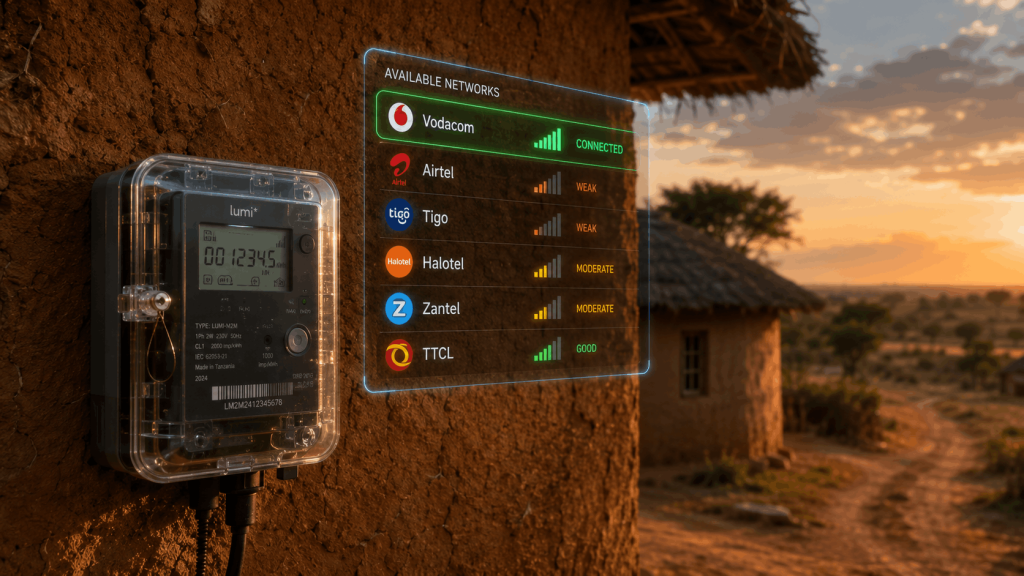
Tanzania has one of the most competitive mobile markets in East Africa. Vodacom, Airtel, Tigo (MIC), Halotel, Zantel, and TTCL all hold licences and operate towers across the country. In Dar es Salaam, that competition drives down prices and pushes up speeds. But step outside the major cities—into the rural districts of Mtwara, Kigoma, Tabora, or Rukwa—and the picture changes dramatically.
A single operator may have the only tower for fifty kilometres. Another may have coverage along the main road but none in the villages branching off it. For utility companies rolling out smart electricity or water meters, this fragmentation is a nightmare.
A smart meter on a single-network SIM is a gamble on which operator happens to hold the tower near that specific pole. If it guesses wrong, the meter reverts to dumb.
Why Tanzania's Operator Diversity Creates a SIM Problem
Challenge
Single-0perator SIM
Multi-Network SIM
Different network footprints
- Limited to one Operator
- Multiple available network
Rural Coverage gaps
- Device may lose connectivity
- Can seek another available network
Tower outage
- Wait for home network
- Potential alternative network
Large-scale deployment
- Multiple Connectivity
considerations
- Standardized connectivity
SIM management
Operator-specific
Centralized management
Data monitoring
Often fragmented
Centralized visibility
The key principle
A licence map is not the same thing as a coverage map. That distinction is especially important for
IoT devices installed in locations where there is no technician nearby.
Multi-Network Roaming: The Meter That Finds its Own Signal
The solution is not to negotiate with all six operators individually. The solution is a single multi-network roaming SIM from GPSSims.com that is authorised to register on any available carrier tower in Tanzania, automatically and in real time.
Our M2M SIMs attach to whichever tower is physically present and strongest at the meter’s location. If the nearest tower belongs to a different brand, the SIM registers there without complaint.
Smart Meter Data Usage: Far Less Than You Think
One of the most persistent myths in utility loT is that smart meters need large data plans. They do not. A typical GSM-enabled electricity meter transmitting a daily reading — timestamp, meter ID, consumption value, and status flags — sends a payload of roughly 200-500 bytes. Even with protocol overhead, TCP handshakes, and occasional firmware update packets, Monthly consumption rarely exceeds 1-3 MB per meter.
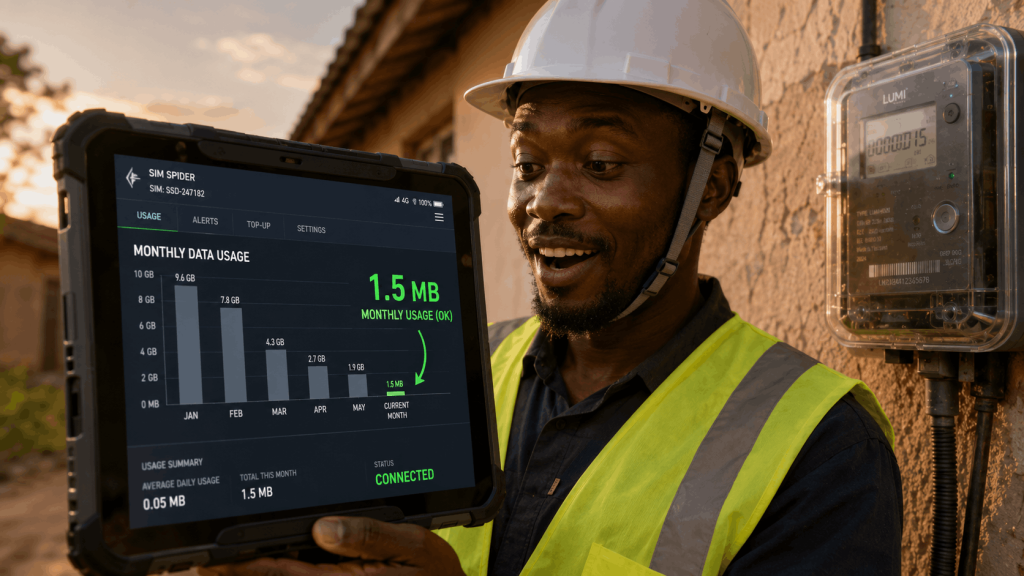
For a water meter with less frequent reporting — say, twice daily plus alarm events — the figure is even lower, often under 1 MB per month. This places almost every smart-meter deployment comfortably within our 5 MB plan at USD 2.00 per month, with enormous headroom for remote commands, tariff updates, and emergency disconnect signals.
Where utilities occasionally overspend is by purchasing high-capacity plans from a single operator under the assumption that “more data equals more reliability.” It does not. A 50 MB plan on a SIM locked to an operator with no rural tower is worthless. A 5 MB plan on a multi-network SIM that can register on whichever of the six operators happens to hold the nearest tower delivers real, measurable uptime.
2G and 3G: The Unsung Heroes of Metering
Much of the smart-meter hardware deployed across Africa — including Tanzania — still relies on GSM/GPRS or 3G modems rather than LTE. The reasons are practical: GSM modules are cheaper, consume less power, and penetrate building materials and meter boxes more effectively than higher-frequency LTE signals. For a meter installed inside a metal kiosk or a concrete utility room, a 900 MHz GSM signal often reaches where a 2.6 GHz LTE signal cannot.
Our multi-network SIMs support 2G, 3G, and 4G fallback automatically. If the only available tower in a rural district is a legacy 2G site, the SIM registers there and the meter transmits via GPRS. If a 3G signal appears, it upgrades. If LTE is present, it uses it. The meter does not need to know which generation it is on. It simply needs a path to the network, and the SIM finds it.
This matters because some operators in Tanzania have prioritised LTE rollouts in urban zones while leaving 2G as the only available service in rural areas. A meter on an LTE-only SIM plan would be entirely blind in those districts. A multi-generation roaming SIM maintains connectivity by falling back to whatever the local infrastructure actually provides.
From the Field: Typical Smart Meter Scenarios
A government-backed rural electrification programme aims to install prepaid smart meters across five thousand households in twenty districts spanning mainland Tanzania and Zanzibar. The districts vary from densely populated Kilimanjaro foothills to sparsely populated Rukwa lake basin. Using single-operator SIMs, the procurement team would need to survey every district for carrier coverage, negotiate separate bulk agreements, and manage multiple APN profiles across the meter management system. With multi-network roaming SIMs, every meter ships with the same SIM, the same APN, and the same data plan. The installer screws the meter to the pole, clips the antenna, and walks away. The meter finds its own network.
A municipal water utility deploys smart meters and pressure sensors across Dar es Salaam, Morogoro, and Dodoma to detect leaks, monitor consumption, and automate billing. In the city centre, coverage is abundant. But in the peri-urban zones where informal settlements sprawl beyond the planned infrastructure, coverage is patchy and operator-specific. A meter in one ward may sit in a Vodacom stronghold; a meter two streets away may only see Tigo. Multi-network roaming eliminates the need for pre-installation site surveys. The utility orders meters in bulk, ships them to contractors, and knows that each meter will find a viable signal regardless of which operator happens to dominate that specific street.
Private mini-grid operators running solar-battery installations in remote villages need to monitor battery state of charge, inverter status, load profiles, and revenue collection in real time. These sites are often beyond the reach of grid electricity and beyond the reach of any single mobile operator. A multi-network SIM that can latch onto whichever carrier has the one tower visible from the village ridge provides the lifeline the operator needs to manage the site remotely. Without it, every minor fault requires a technician to drive for half a day, burning diesel and wages for a problem that could have been diagnosed and fixed remotely.
Platform Control: Sim Spider for Meter Management
Deploying thousands of meters is only the beginning. Keeping them connected, monitoring their data usage, and managing their lifecycle at scale is where most utility loT programmes stall. Our Sim Spider Platforms is designed for exactly this operational reality:
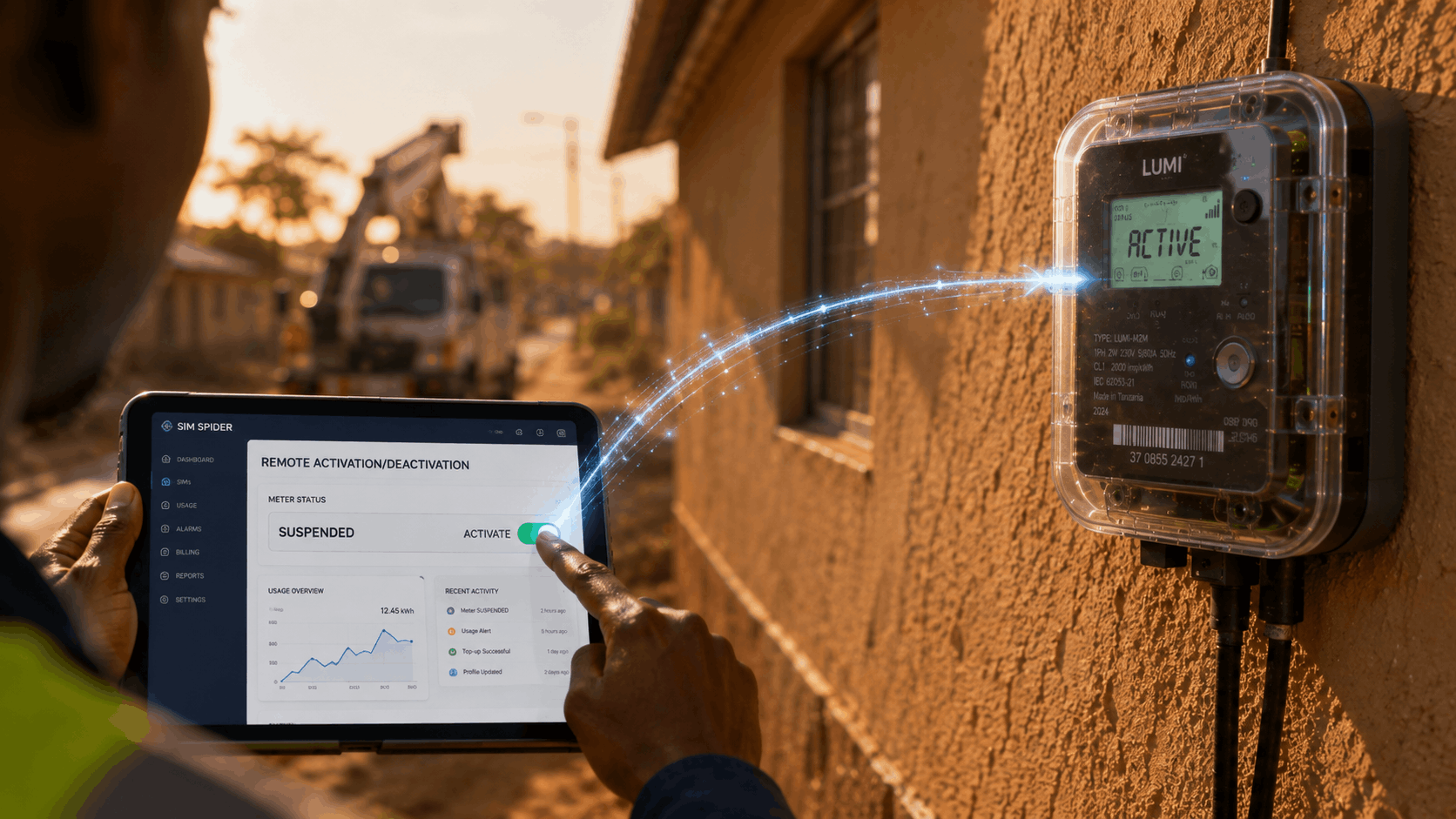
Remote activation and deactivation:
A meter can be activated the moment it is installed, or held in reserve until the customer is connected. If a customer defaults on payment, the SIM can be suspended instantly from the web portal — no truck roll required.
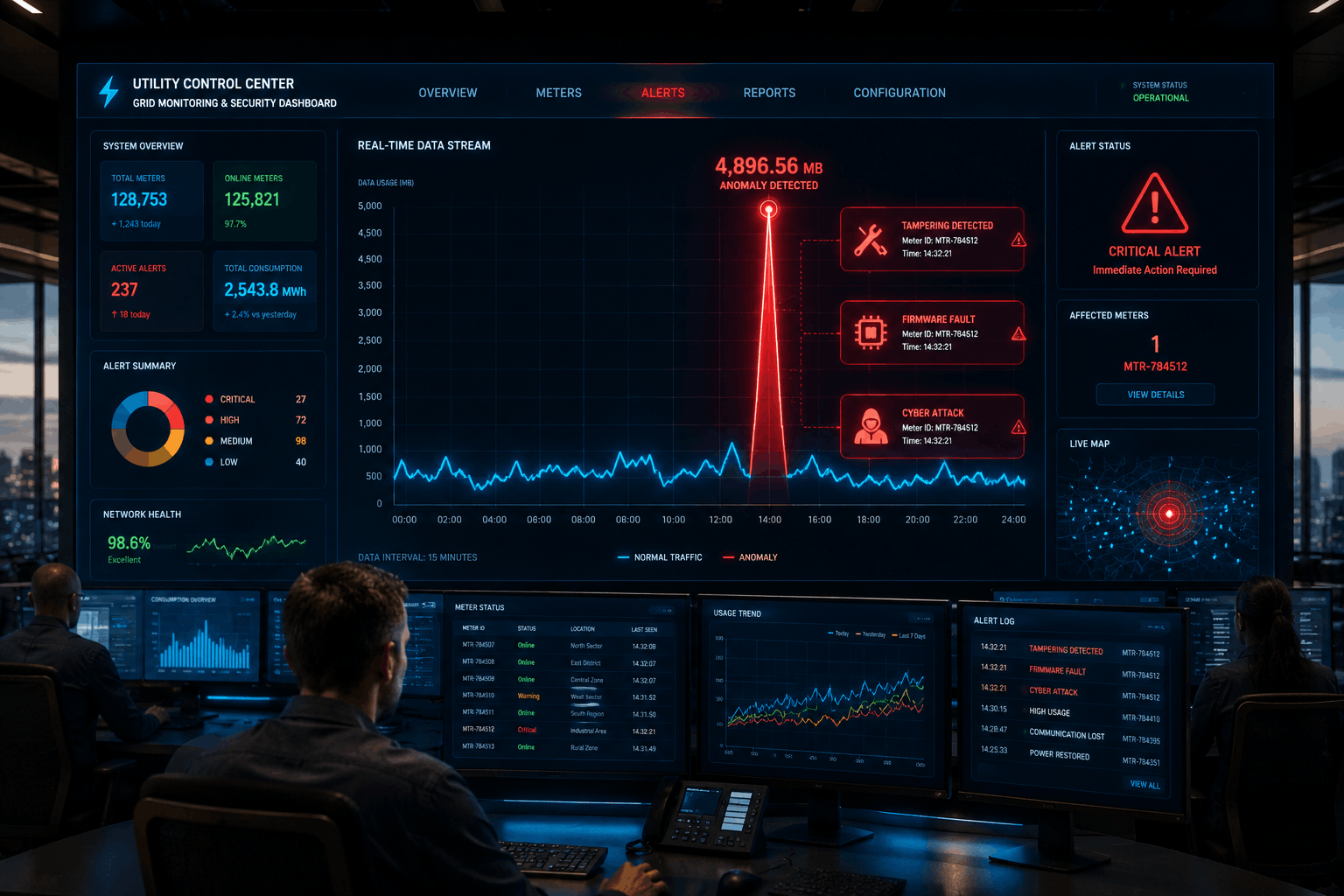
Real-time usage monitoring
Each SIM's data consumption is tracked against its monthly plan. A meter that suddenly consumes ten times its normal volume may indicate a firmware fault, a tamper attempt, or a denial-of-service attack on the modem. The utility sees the anomaly immediately.
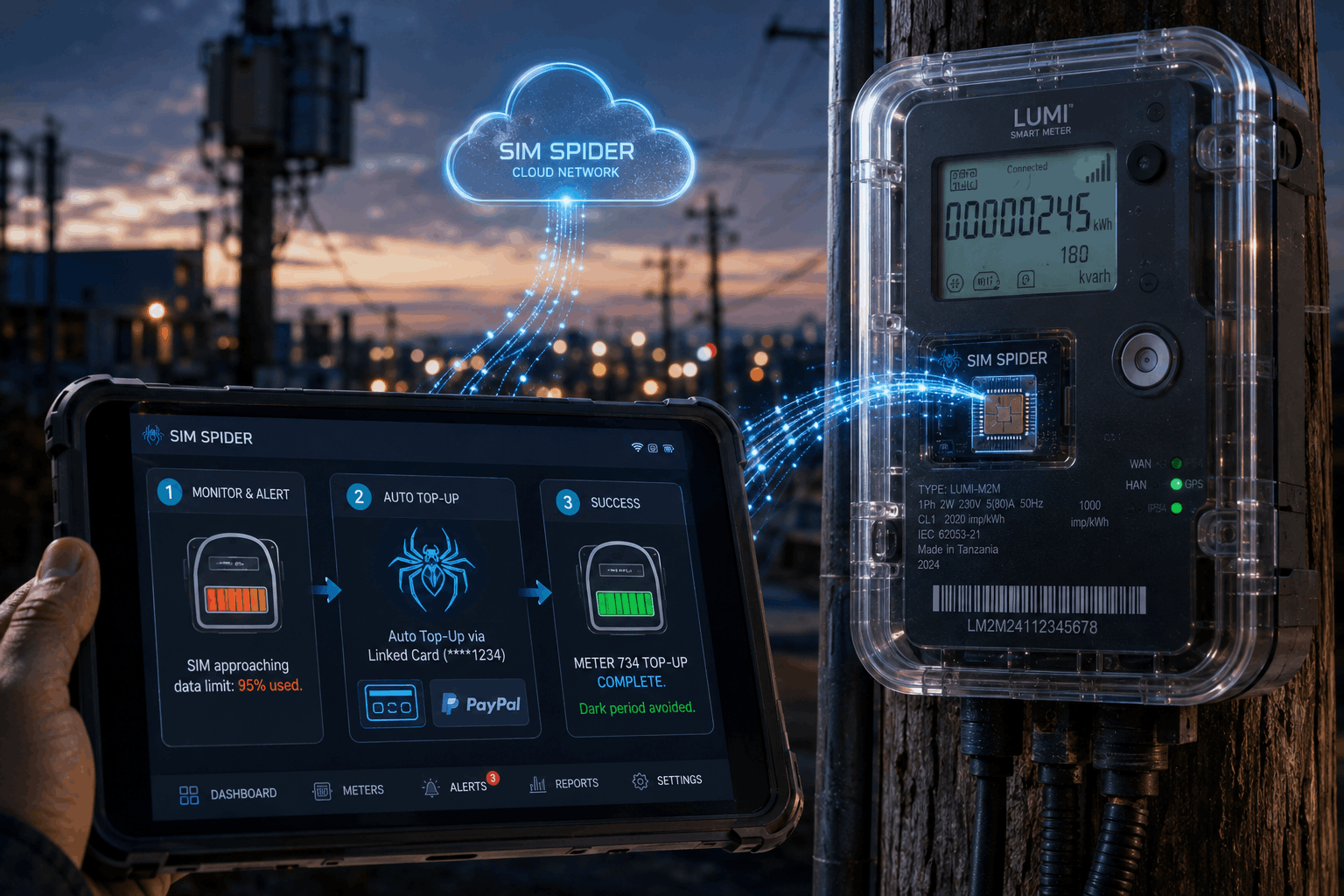
Automated top-up
When a SIM approaches its data limit, Sim Spider can trigger an automatic top-up via credit card or PayPal, ensuring the meter never goes dark during a critical billing cycle.
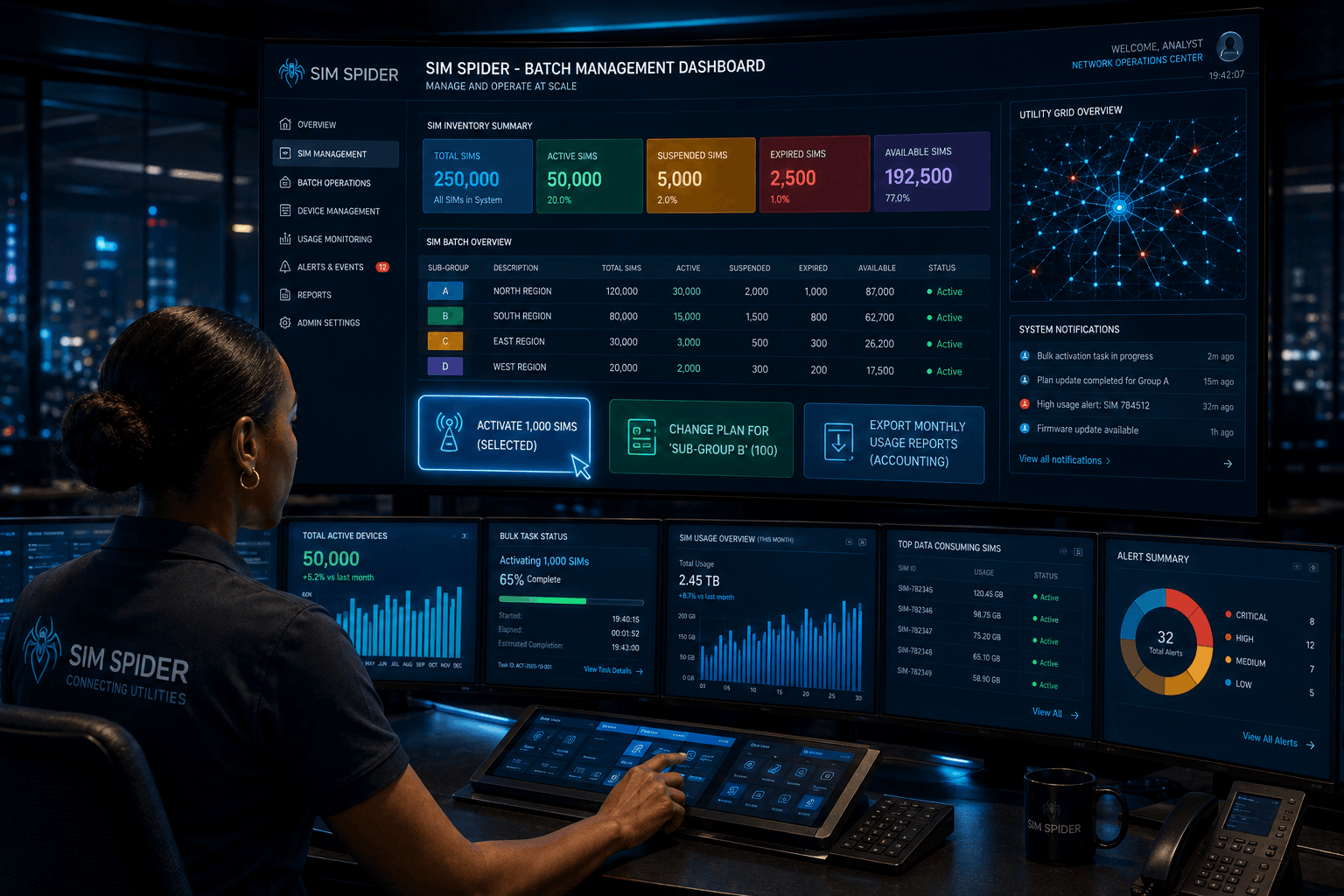
Batch management
Utilities do not manage meters one by one. Sim Spider supports bulk operations — activate a thousand SIMs, change the plan on a hundred, export usage reports for accounting — all from a single dashboard.
For a utility CFO, this visibility turns connectivity from an opaque cost centre into a manageable line item. For a field operations manager, it removes the guesswork of which meter is offline and why.
The Bottom Line
Tanzania’s mobile market is a strength, not a weakness — but only if your smart meters can exploit it. Six operators means six separate coverage footprints, six separate tower maintenance schedules, and six separate signal profiles across every village, estate, and district. A single-network SIM turns that diversity into a liability. A multi-network roaming SIM turns it into resilience.
For utilities rolling out smart metering at scale, the cost of a roaming SIM is trivial compared to the cost of a failed rollout: manual meter-reading fleets, disputed bills, revenue leakage, and customer churn. The meter that finds its own signal — on Vodacom today, Airtel tomorrow, Halotel next week — is the meter that justifies the digital investment. If your smart-meter deployment spans urban Dar es Salaam, peri-urban Dodoma, or rural Mtwara, the question is not whether multi-network roaming is necessary. It is whether you can afford to discover, one village at a time, that your single-operator SIM was the wrong bet.
Office: +44-2033188 201-7
Web: https://ext.m2mgs.com
M2M Global Solutions Ltd
20-22 WENLOCK ROAD, ISLINGTON- LONDON, N1 7GU, United Kingdom